

Black people never had the opportunity to fully incorporate the American nuclear family as it was experienced in non-Black America. Why? The government created the nuclear family structure after WWII to rebuild white America. The country did not consider Black Americans as equals or citizens. Negroes did not live the same way, were not treated the same, and did not earn the same as anyone else after emancipation. The impact of Jim Crow laws significantly shaped these disparities.
by Kenya N. Rahmaan
The Great Migration caused family displacement and separation similar to, but not exactly like, slavery. Most Black fathers did not live with their families because they were, most often, searching for work. Black mothers could not remarry if he didn’t return because she was still contractually married. That is why it appears that Black people lived in nuclear families comparable to white people in greater numbers than were actually occurring.
The principal problem, and the proper focus of public concern, is that of the Negro male worker. His plight does not seem to im prove. Income rises. Year-round, full-time workers gained almost $1,000 in the short period from 1957 to 1963. But positions relative to white workers did not improve.
–Daniel Patrick Moynihan, 1965
Black family structures were never comparable, but assimilation was the overall mission for the elitist who reluctantly came to grips with the fact that the ‘Negro problem’ was not going away. No matter the era or the number of possibilities people muster in attempting to sway accountability for centuries of racist and discriminatory treatment, the ideology does little to avert responsibility away from the United States of America. Few can disagree with the progress Black America has made since emancipation. Additionally, the absence of racist violence and terrorism by groups like the Ku Klux Klan (KKK) would have guaranteed unmatched expedited financial and familial progress.
Yet, the allowance of welfare benefits remains at the top of the list of catalysts that allegedly destroyed Black families. Many ignore that despite Black American societal growth, Black people are still devastated by systemic, medical, environmental, institutional, and financial racism. Whether isolated or combined, the result is generational decay and extreme poverty. A favorite attribution to the separation of generations of Black life in America is the governmental implementation and enforcement of the ‘man in the house’ or substitute parent guideline.
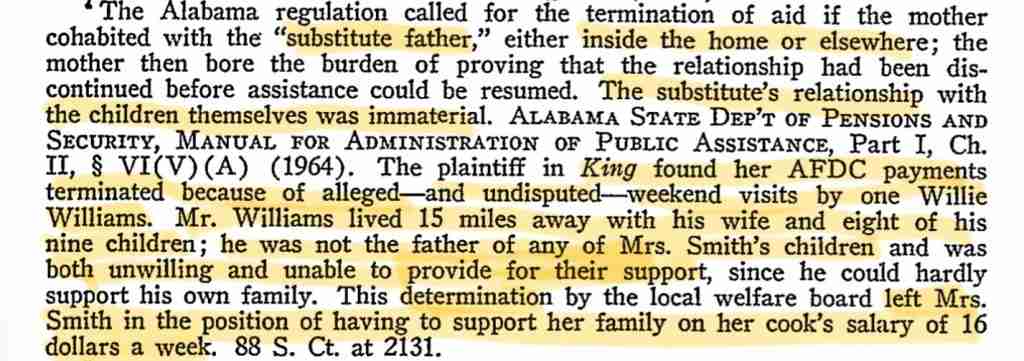
Social Welfare — The “Man in the House” Returns to Stay
C. Frank Goldsmith Jr., 1968
The ‘man of the house’ rule functioned as a deterrent for women who gave birth out of wedlock from engaging in promiscuous behavior, which led to illegitimate births in the Black community. Certainly, white women were promiscuous and birthed illegitimate children, but just as the nation hides data that juxtaposes differences in Black and non-Black families, demographically specific information is well hidden from the public. By implicating the welfare-seeking, promiscuous, and lazy Black woman as the person who would rather marry the government than the father of his children, the true causes of any dysfunctionality within the Black culture are easily explained away.
Society cannot ignore those who continually discuss how income gaps between Black and non-Black Americans rapidly decreased during Jim Crow. The ability to earn money for one’s labor, compared to earning nothing, guarantees better financial health. After 400 years of free labor, countless family separations, and releasing millions from centuries of bondage without reparations, welfare is at the bottom of contributions America has distributed to Negroes that can be connected to destroying Black familial units. Not Black nuclear families, mind you, but Black villages.
Finally, John F. Kennedy, Jr., before he was tragically assassinated, was working on welfare reform. One of the greatest changes implemented when Aid to Dependent Children (ADC ) was reformed to Aid to Families with Dependent Children (AFDC) was that the latter added work requirements for the new influx of Black families who had better chances of being approved for assistance. Lyndon Baines Johnson, known affectionately as LBJ, faced the bulk of the scrutiny for declaring the War on Poverty and starting to introduce the Great Society. By the time Johnson passed the civil rights & voting rights bills, Black Americans had only qualified for benefits under the new program for less than five years. The government simply could not gather enough information to accurately determine if 1. the welfare state caused the damage to Black people and families and 2. if Black America was situationally ‘better off’ before, during, and after Jim Crow. Arguably, the second cannot return a definite answer because Jim Crow continues. The Top 10 Deflections in Every Reparations Debate And Why They Fall Apart on Closer Inspection.
Stay in the loop
No matter the era or the many possibilities, few can disagree that Black America has progressed since emancipation. Unfortunately, safety net programs remain the top scapegoat for the alleged Black family destruction. Many ignore that despite Black American societal growth, the culture is devastated by systemic, medical, environmental, and institutional racism. Whether isolated or combined, the result is generational decay and extreme poverty. We, as a society, are causing a grave injustice to future generations by omitting key components of American Black history.